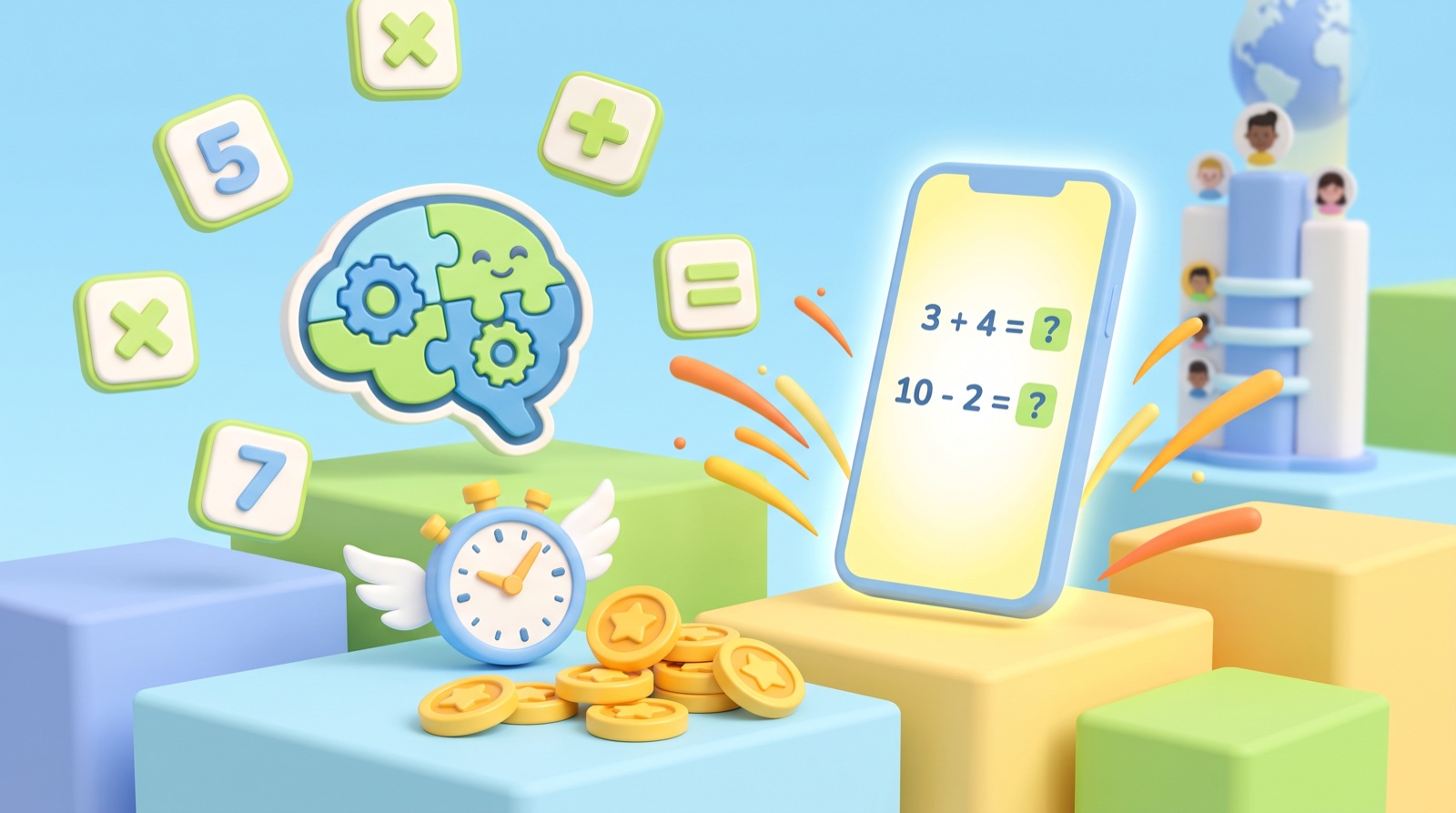
Mental math is good for your brain in a narrow, practical sense. It gives you repeated practice with attention, number patterns, memory for familiar facts, and quick decisions under light pressure.
That does not mean every arithmetic game will make you smarter at everything. The better promise is simpler: if you practice mental math, you can get faster and more confident at mental math. For most players, that is already useful.
The short answer
Mental arithmetic practice can help you build number sense, recall common patterns faster, and feel less rusty with everyday calculations. Research on mental calculation has found that practice changes how people solve arithmetic problems, with more answers coming from memory and automatic recognition over time.
One study indexed in PubMed describes this shift from slow, conscious calculation toward more automatic answer retrieval after practice. That is exactly what many people feel after repeating the same kind of addition or subtraction round for a few days: the problem stops looking new every time.
A useful way to think about it
Mental math is like practicing a small sport for numbers. You are not training every muscle. You are training the moves you repeat.
What mental math actually trains
Good mental math practice trains a few useful habits at once.
- Number sense: spotting that 19 + 7 can become 20 + 6.
- Recall: remembering common sums, differences, and patterns faster.
- Attention: staying with the numbers instead of drifting.
- Error recovery: missing one answer and still finishing the round.
- Speed under pressure: making quick choices without turning every answer into a panic.
Adult numeracy guidance from Kent State's Ohio Literacy Resource Center puts estimation and mental math inside a broader idea of number sense for adults. The useful skill is not just doing paper calculations. It is knowing when an answer feels reasonable and what method fits the moment.
That is why short arithmetic games can be helpful. A fast round gives you lots of small decisions. Over time, your brain gets more chances to recognize the same shape again.
What mental math does not magically do
Mental math is often sold as if it trains the whole brain. That is too broad. Arithmetic practice is best understood as practice for arithmetic, number confidence, focus during short tasks, and speed with familiar patterns.
It should not be treated as therapy, medical treatment, or a guaranteed boost for every kind of memory. If you enjoy the game and return to it, that is enough. The habit does not need miracle claims to be worth doing.
There is another caution. Timed math can make some people tense. The American Psychological Association has written about math anxiety and how the fear around math can affect performance and choices. If the clock makes you freeze, start slower. Accuracy first, speed later.
Can adults still improve at mental math?
Yes. Adults can improve, especially when the practice is short enough to repeat. You do not need to go back to school worksheets. You need frequent contact with numbers, clear feedback, and a level that is hard enough to make you pay attention.
This is where a mobile game can work well. Tally Rush gives you short runs, levels, Daily Challenge, Duel, and Arena attempts. The game does not ask you to study theory before you start. It gives you a score, then asks if you can beat it.
How to make mental math practice work
The best mental math routine is small and repeatable. Five minutes that you play again tomorrow is better than a long session that makes you avoid the app for a week.
- Pick one level and repeat it until the pattern feels familiar.
- Use the timer as pressure, not as judgment.
- Track one score, not ten different stats.
- Notice one mistake pattern after each round.
- Move up only when the current level still feels fun.
YouCubed's Fluency Without Fear makes a useful point: fluency is not only memorization under pressure. Number sense matters too. In a game, the clock can be fun, but it should not replace thinking.
The National Academies report Adding It Up describes mathematical proficiency as more than one skill. Procedural fluency matters, but so do understanding, strategy, reasoning, and attitude. A good math game should respect that mix.
Where Tally Rush fits
Tally Rush is built for the small, repeatable version of practice. Rush Mode gives you levels to master. Daily Challenge gives you a reason to come back. Duel adds a 60-second rival. Arena turns three attempts into one global score.
If you want a simple starting point, read our 7-day daily mental math challenge. If speed is the main goal, use the guide on how to get faster at mental math. If you are comparing apps, start with our guide to the best mental math games for adults.
FAQ
Is mental math good for your brain?
It can be good practice for number sense, attention, arithmetic fluency, and confidence with numbers. It is better to think of it as specific training, not a promise that every part of your thinking will improve.
Can adults improve at mental math?
Yes. Adults can improve with short repeated practice, especially when they repeat useful problem types and keep the level challenging but not miserable.
How much mental math practice is enough?
Start with a few minutes a day. If you can repeat it, you are more likely to get the benefit. A small daily habit beats occasional marathon practice for most people.
Is timed mental math bad?
Timed math is not automatically bad. It can make a game more exciting. The problem is when the timer makes you anxious or turns every mistake into judgment. If that happens, lower the difficulty and rebuild accuracy first.
Try a fast round
Download Tally Rush
Use Rush, Daily Challenge, Duel, and Arena to turn mental math practice into short score-chasing rounds.