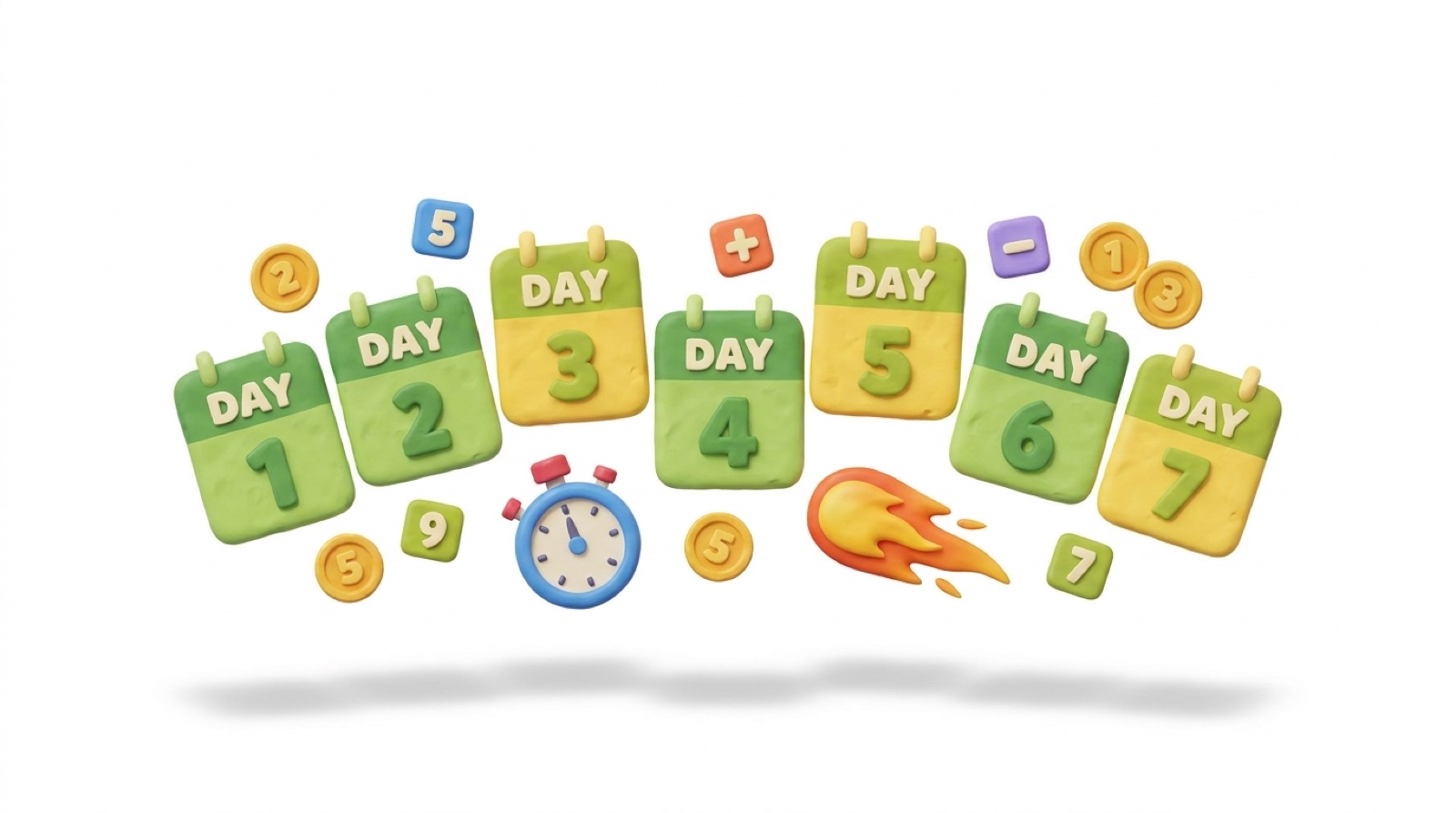
A daily math challenge works best when it is small enough to repeat. The mistake is trying to turn mental math into a huge self-improvement project. Most people do better with one short round, one score, and one reason to come back tomorrow.
That is the idea behind this 7-day challenge. You will use fast arithmetic rounds to build a small habit. Some days are about clean accuracy. Some days add timer pressure. Some days bring in competition, daily rank, or a leaderboard target.
Why seven days is enough to learn something useful
Seven days will not turn anyone into a calculator. That is fine. The goal is simpler: find out whether short daily practice helps your number instincts feel faster and less rusty.
Learning research gives a useful hint here. The What Works Clearinghouse guide on study practice recommends using quizzing to re-expose learners to key content. The National Academies report Adding It Up also treats procedural fluency as one part of mathematical proficiency. In plain language: answering from memory, then coming back later, is useful.
Tally Rush turns that into a game loop. You answer quickly, see a score, try to improve, then return the next day before the habit goes cold.
The rules for the challenge
Keep the rules light. Heavy rules make practice feel like homework, and that is exactly what this challenge is trying to avoid.
- Play once a day for seven days.
- Keep each session under five minutes unless you are having fun.
- Start with accuracy, then add speed.
- Repeat one level before jumping to harder levels.
- Write down only one number each day: your best score.
- Stop while you still want another try.
Make it a game, not a test
Timed math can feel stressful when it turns into judgment. Treat each round as a score attempt. Misses are part of the run, not proof that you are bad at math.
That last point matters. YouCubed's Fluency Without Fear is a useful reminder that math fact fluency should not depend only on pressure and memorization. For a game, pressure is useful when it feels playful. It stops being useful when it makes you freeze.
If timed arithmetic makes you tense, keep the challenge gentle. The American Psychological Association's overview of math anxiety is a good reminder that the feeling around math can affect the experience as much as the numbers themselves.
The 7-day daily mental math challenge
Day 1: Set your baseline
Open Tally Rush and pick a Rush level that feels comfortable. Play one clean round. Do not chase a perfect score yet. Your job is to get a baseline.
Write down your score. If you notice one mistake pattern, remember it. Maybe you lose time on subtraction. Maybe the clock makes you rush the last answer. That is enough for day one.
Day 2: Repeat the same level
Play the same Rush level again. This is the boring part that actually helps. When the same type of problem returns, your brain gets another chance to recognize the pattern faster.
Your target is not a huge jump. Aim for one cleaner run. If your score improves, good. If it does not, look at accuracy. A lower score with fewer wild guesses can still be progress.
Day 3: Add a timer target
Now make the clock part of the challenge. Before you start, choose a tiny target: one more correct answer, one fewer mistake, or one longer streak.
This is where a phone game helps. A paper drill can feel open-ended. A timed round has shape. It starts, it pushes you, and it ends.
Day 4: Play the Daily Challenge
Use the Daily Challenge as your main run. One fresh official run is useful because you cannot keep restarting forever. You get a score, a rank, and a reason to return tomorrow.
Do not overthink the result. The daily run is there to make the habit easy. Open the game, take the run, record the score, move on.
Day 5: Try one Duel
On day five, add another kind of pressure. Play one Duel. A 60-second head-to-head round changes the feeling because you are not only racing the clock. You are trying to beat a rival.
Competition is useful if it makes you focus. If it makes you tap too fast, slow down for the next run. The best score usually comes from quick answers that are still under control.
Day 6: Take an Arena attempt
Use Arena for a ranked score attempt. You get three attempts, and one score goes worldwide. That gives the challenge a different kind of finish: not just "did I practice?" but "what score can I put up today?"
Keep your goal simple. Try to beat your own week-best score, not everyone else's score. Leaderboards are better when they give you energy instead of making the target feel impossible.
Day 7: Repeat your baseline level
Go back to the Rush level from day one. Play it once, then compare the score with your first run. Look for three things: speed, accuracy, and how the round felt.
The feeling matters. If the numbers looked less messy, the timer felt less loud, or you recovered faster after a mistake, the week did its job.
What to track during the week
Do not build a spreadsheet unless that is your idea of fun. Track only the numbers that change your next run.
- Best score of the day.
- One mistake pattern you noticed.
- One level or mode you want to repeat.
- Whether you wanted another round when you stopped.
That last item is underrated. The best practice routine is the one you want to repeat. National Numeracy's public numeracy challenge starts from a similar human place: however you feel about math, you are not alone. A good routine should make numbers feel more approachable, not heavier.
What to do after seven days
If the challenge helped, do not make it bigger right away. Keep the habit small for another week. Pick one anchor: Daily Challenge every morning, one Duel after work, or three Arena attempts on Sunday.
If the challenge felt too easy, move one Rush level higher. If it felt stressful, drop back to a level where you can stay accurate. The right level is the one that makes you think without making you hate the clock.
You can also use this challenge with the broader advice in our guide on how to get faster at mental math. If you are still choosing an app, our guide to the best mental math games for adults explains which style of practice fits which kind of player.
FAQ
What is a daily mental math challenge?
It is a short arithmetic routine you repeat once a day. The best version has a clear start, a timer or score, and one small target to beat.
How long should a daily mental math challenge take?
Keep it under five minutes at first. A short challenge you repeat every day is usually more useful than a long session you avoid.
Can I do a mental math challenge on my phone?
Yes. A phone is a good fit when the game starts quickly, gives clear feedback, and lets you play one round without setup.
Try the challenge
Download Tally Rush
Use Rush, Daily Challenge, Duel, and Arena to turn one week of mental math practice into a score you can beat.