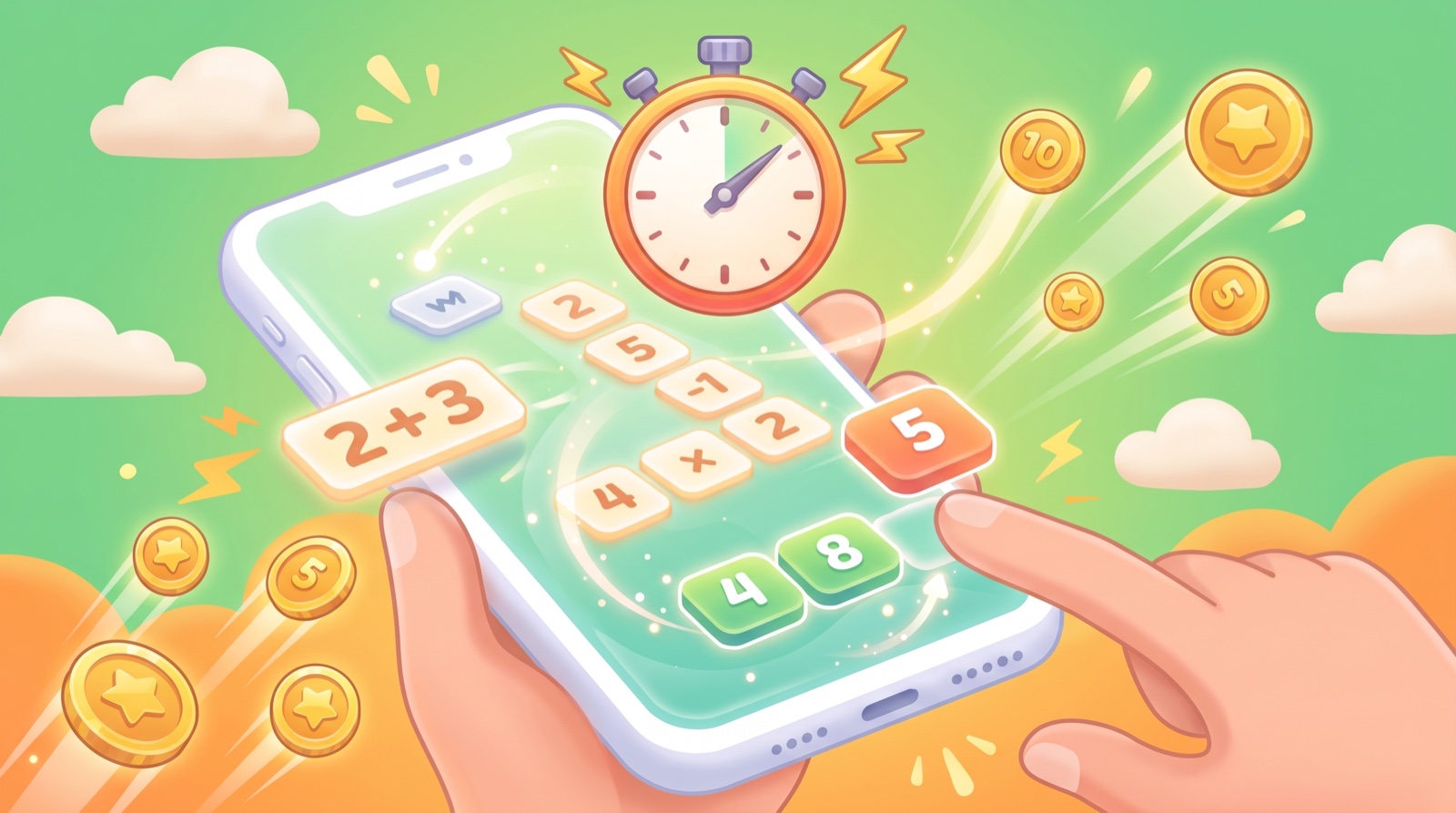
The fastest way to get better at mental math is usually not more theory. It is more clean repetitions. That is part of procedural fluency in mathematics: knowing what to do and doing it smoothly. You want your brain to see common number patterns so often that it stops treating every sum like a new problem.
That is why long, serious practice often fails. It asks too much too early. A better plan is lighter: play a few fast rounds, notice what slows you down, repeat the level, and try to beat your own score.
Start with short rounds
If mental math practice feels like homework, you will avoid it. Keep the first step small enough that it is hard to say no. Two or three minutes is enough to start. One round while waiting for coffee is enough. A quick level before opening another app is enough. The point is fluent retrieval of basic arithmetic facts, not a long study session.
Short rounds work because they remove the ceremony. You do not need to prepare. You do not need to block time. You start, answer as many questions as you can, and stop before it becomes a chore.
Use timed pressure, but keep it playful
Speed needs pressure. If there is no clock, you can drift. A timer forces quick decisions, and quick decisions reveal the small weak spots that slow you down.
The pressure should feel like a game, not an exam. That difference matters because timed tests can create math anxiety when they feel like judgment instead of play. In Tally Rush, Rush levels push you to keep answering before the timer runs out. Duel gives you 60 seconds against a rival. Daily Challenge gives you one clean run for the day. Arena gives you three attempts to put up your best score.
That kind of pressure is useful because the round ends. You can try again without turning a mistake into a big event.
Do not practice everything at once
Pick one difficulty or one type of problem. Repeat it until your answers feel smoother. Speed comes from familiar patterns, not from jumping around every ten seconds.
Repeat levels until the patterns look familiar
Mental math speed improves when the same patterns show up again and again. You start to recognize pairs that add cleanly. You spot small multiplication facts faster. You stop wasting time on the first step.
Repeatable levels help because they give you a clean target. If level 4 feels messy today, play level 4 again tomorrow. If your score jumps, you know something changed. If it does not, you know where to focus.
This is also why score chasing works. A score gives practice a shape. Instead of saying, "I should improve my mental math," you can say, "I want five more correct answers on this level."
Review the mistakes that cost you time
You do not need a full lesson after every wrong answer. You do need a quick pause sometimes. Ask one simple question: what slowed me down? That is the useful part of deliberate practice: repeat the thing that is actually holding you back.
Maybe you know addition well but freeze on subtraction. Maybe multiplication is fine until the numbers get close to 9. Maybe you are accurate when calm, then tap too fast when the timer gets low. The answer tells you what to repeat next.
Accuracy matters because wrong answers are expensive. Fast mental math is not random tapping. It is quick pattern recognition plus enough control to avoid giving points away.
Build a daily habit that is almost too easy
The best mental math practice is the one you repeat. A small daily habit beats a long session you only do twice.
Tie the habit to something that already happens. Play one round after breakfast. Play the Daily Challenge after school or work. Play one Duel before bed if that does not keep you wired. Keep it simple enough that missing a day does not feel like failure.
Daily practice helps because your brain keeps the patterns warm. You return before the skill has gone cold.
Make it a score, not a worksheet
Scores change the feeling of practice. A worksheet asks you to finish. A score asks you to improve. Research on the gamification of learning gives a useful lens for why goals, feedback, and progress can change how practice feels.
That difference matters. When you are chasing a score, the next round has a reason. You remember the level you nearly cleared. You notice the friend who beat you in Duel. You want one cleaner run in Arena.
That is the sweet spot for Tally Rush: fast arithmetic practice that feels like play. You get short rounds, timed pressure, repeatable levels, daily challenges, and enough score chasing to keep the habit alive.
A simple plan for the next seven days
Start with one Rush level that feels easy enough to finish but hard enough to make you think. Play it once a day for a week. Write down nothing unless you want to. Your only job is to notice whether the answers feel faster by the end of the week.
If it gets too easy, move up one level. If it still feels messy, repeat it for another week. The goal is not to prove you are good at math. The goal is to make speed feel normal.
Quick answers
How can I get faster at mental math?
Practice in short timed rounds, repeat the same difficulty, and review the mistakes that slow you down. Speed improves when common number patterns become familiar.
How much should I practice each day?
A few focused minutes can be enough to build momentum. Short daily practice is easier to keep than a long session that feels like schoolwork.
Is timed practice good for mental math?
Yes, if the pressure stays playful. A timer helps you make decisions faster, and a short round gives you a clear endpoint.
Can Tally Rush help me improve mental math speed?
Tally Rush gives you fast arithmetic rounds, repeatable levels, daily challenges, and scores to beat. It works best as a small habit you can repeat often.
Make the next round faster
Try Tally Rush on iPhone or iPad.
Play quick mental math rounds, chase better scores, and build a daily number habit without turning practice into homework.